Joël Watanabe (Bao Bei, Kissa Tanto, Meo): Business Is About People
When his restaurants were short-staffed recently, seven of Joël Watanabe's former cooks came back to help on busy nights. Former cooks. People who had already moved on. That's the kind of loyalty you can't buy with a wage bump.
Watanabe is the chef and co-owner behind three rooms in Vancouver's Chinatown: Bao Bei, Kissa Tanto and Meo. Kissa Tanto has held a Michelin star since the guide arrived in Vancouver in 2022. Ask him how he got here and he doesn't talk about stars. "Business is about people," he told Tastet this month.
A tofu family, a summer camp and 14 years on the line
Watanabe grew up in Ottawa. His mother is French-Canadian from Northern Ontario, his father is Japanese, and the two met in their early twenties hitchhiking in Guatemala. When Joël was five, his father started making tofu at home. That kitchen-table project grew into La Soyarie, one of the country's largest tofu makers.
He started cooking for the same reason a lot of chefs do: to get out of something worse. At nine or ten, he took over family dinner once a week so he wouldn't have to wash dishes. His first real kitchen was at Au Grand Bois, a vegetarian summer camp where he'd been a camper and then a counsellor. He ended up running it, feeding 105 people three meals a day.
By 17 he was working in Ottawa restaurants and training in sushi. Then came years in Montreal, bouncing between Café Méliès, bistros, the private club 357c in Old Montreal, sushi counters, and French and Italian kitchens. He came back to Ottawa in his mid-twenties as opening chef of Kinki. A project in Whistler didn't last, but he stayed west.
Around 30, after roughly 14 years of near-constant cooking, he stopped. He went rock climbing in Thailand, picked grapes in Australia, and cooked at The Point on Albert Park Lake in Melbourne under Scott Pickett. Later came Bin 942 in Vancouver, some consulting, and a resort kitchen in Saint Lucia.
That break matters more than it looks. Most cooks who hit 14 years without stopping either burn out or get out. Watanabe took the time off and came back. If you're running on fumes yourself, burnout is worth taking seriously before it makes the decision for you.

Reservation software. Free for Canadian restaurants. $0 a month
The partner who wasn't a chef
The partnership that built all three restaurants started with a friend of a friend. Derek, a fellow alumnus of Araxi in Whistler, was working at Chambar with a bartender named Tannis Ling. She was getting ready to open her own place and needed a chef.
That place became Bao Bei, a Chinese brasserie at 163 Keefer Street, in 2010. The menu started with Shanghainese and Taiwanese cooking run through French technique, and it has widened since into a broader pan-Asian menu. Air Canada's enRoute put it at No. 2 on its list of Canada's best new restaurants. Michelin's inspectors still describe Watanabe's cooking there as "inventive and fun."
A lot of chef-owner pairings break down over who gets to decide what. This one started from complementary skills: Ling knew bars and dining rooms, Watanabe knew kitchens. When Bao Bei worked, they had a choice that every successful independent faces. Hold on to the one thing that works, or risk it on a second. They built something new together.
Up a staircase on East Pender
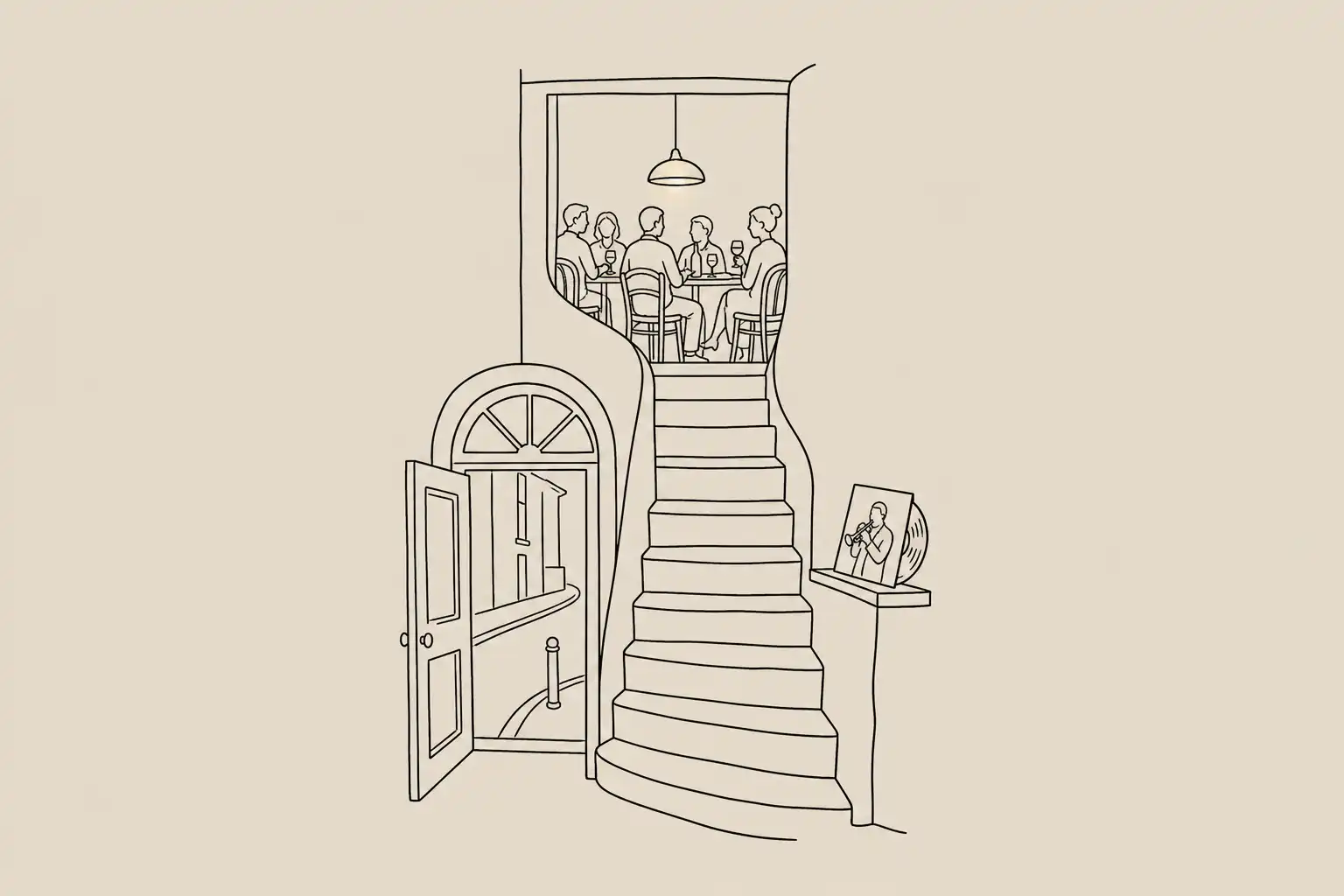
Kissa Tanto opened in June 2016 at 263 East Pender, up a flight of stairs, with 80 seats and a room designed by Ste Marie. This time Watanabe's longtime sous-chef, Alain Chow, came in as a third partner. The name is a pairing: kissa for the jazz cafés of 1960s Tokyo, tanto for "a lot" in Italian. The food follows the name. Scout Magazine's opening write-up listed tortellini in Parmesan dashi, boar lasagne and a layered pork and squid tonkatsu.
Four months later, enRoute named it Canada's best new restaurant. Canada's 100 Best followed. In 2022 it picked up one of Vancouver's first Michelin stars, along with the guide's Service Award, and it has kept the star every year since.
One of the dishes Michelin singles out is a tiramisu with a plum wine-soaked tofu filling. A chef whose father built a tofu company putting tofu in a tiramisu: you couldn't write that more neatly if you tried.
In early 2024 the trio opened Meo, a 70-seat 1970s-style cocktail and snack bar at street level, directly below Kissa Tanto. Ling called it "the second piece of the puzzle to our tri-level building" and said the goal was for it to be "the neighbourhood hangout." There's a jukebox.
What keeps people coming back, on both sides of the pass
Watanabe's philosophy is short. "We've always stayed true to ourselves," he says. "Our focus is to do a good product and be a welcoming place." He has no patience for fine dining that lectures guests who never asked for a lesson.
The same idea runs through how he treats his team, and this is where the seven cooks come in. "Showing care and compassion for the people that work for you is the number one thing," he told Tastet. "You have to actually care about people and show that you care about people. And then those people will care for you."
That's not a soft take. It's an operating decision with a return. A cook who left on good terms is a cook who picks up the phone on a short-staffed Saturday. One of his former sous-chefs now runs Magari by Oca, a pasta shop Watanabe recommends by name. People who leave his kitchens tend to stay in his orbit.
His own read on himself is telling. Asked how he wants to be remembered, he said as a demanding chef who grew kinder and more patient, and as a good leader and father. Plenty of chefs never make that turn. The ones who do usually find it's what lets them keep going past year 20.
What other independents can take from this
Three things stand out.
Pick the right partner, not the most similar one. Watanabe needed a room and a bar. Ling needed a kitchen. Sixteen years and three restaurants later, the partnership still holds.
Grow where you already are. Bao Bei, Kissa Tanto and Meo sit within a few blocks of each other. The newest one is literally downstairs from the second. Every expansion built on regulars, suppliers and a neighbourhood they already knew.
Treat former staff as part of the team. The industry spends a lot of energy on hiring. Watanabe's story is a reminder that how people leave is part of what keeps restaurant staff around, and that alumni are a bench you can call on.
It's the same pattern behind Terrence Feng's partnerships across town: trust first, lease second. For Watanabe, the star is the part people notice. The cooks walking back through the door on a busy night are the part that makes it last.
Sources: Tastet, Scout Magazine, Michelin Guide (Kissa Tanto), Michelin Guide (Bao Bei), Air Canada enRoute via Newswire, Daily Hive, Reporter Gourmet.