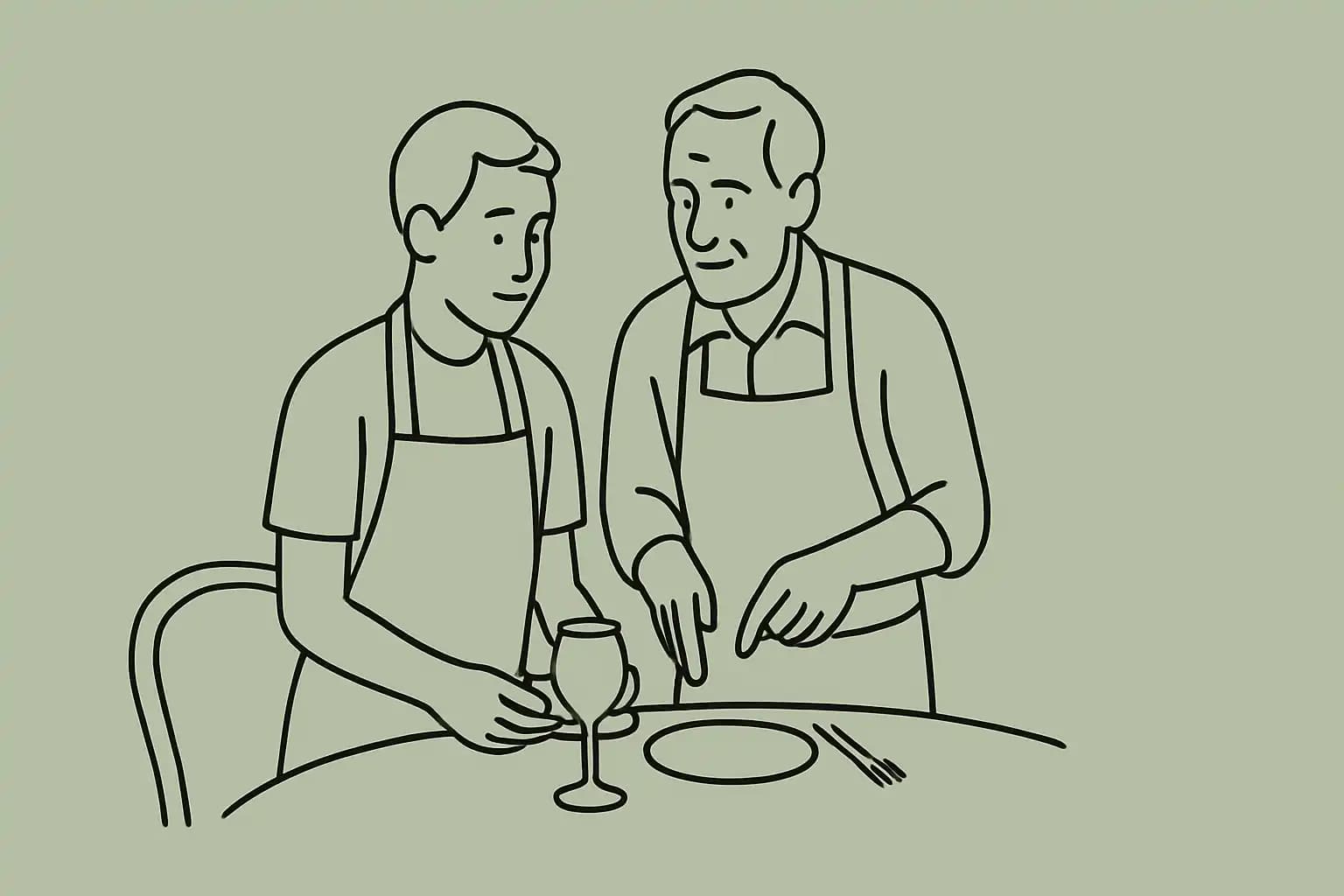
Restaurant Burnout: What Owners Can Do
Seventy percent of restaurant owners hit burnout within their first five years. Not because they're weak or disorganized, but because the industry was built around the assumption that someone would always be willing to work 60-hour weeks for the love of the craft. That assumption stopped being true a while ago.
The numbers back this up. 76% of hospitality workers now report experiencing mental health issues during their careers, up from 56% in 2018. The restaurant industry scores 98 out of 100 on the burnout scale, higher than any other sector. And 63% of chefs report depression.
This is not a "take a bubble bath" problem. It's structural. Here's what you can actually do about it, starting with yourself.
Why the usual advice doesn't work for independents
Most burnout content is written for chain restaurants with HR departments, wellness budgets, and managers who don't also do prep. If you're running a 30-seat restaurant where you're the owner, the expediter, and the person fixing the dishwasher at 11 p.m., advice like "delegate more" or "hire a wellness coordinator" feels almost insulting.
The real issue isn't that you work hard. Peter Keith, chef and director of the eHUB Entrepreneurship Centre at the University of Alberta, puts it clearly: hard work doesn't cause mental health issues. What causes them is a structure where recovery never happens. Long hours, unpredictable scheduling, constant proximity to alcohol, and the social isolation of working when everyone else is off. Stack those for years without relief and something breaks.
An operator on Reddit captured the feeling perfectly: "Your body doesn't know you are running a business, it thinks you are being hunted."
Owners who love the work say the same thing. Thirteen years into running three restaurants on one Halifax block, Craig Flinn described what he had become as a business person as the single biggest source of stress in his life: 53 staff, the costs, everything that goes wrong in the run of a day. In the same interview he said he seriously loves to cook and feed people, and that on a busy line he is zen-calm. Both things are true at once, and that is exactly the shape of the problem.
So the goal isn't to work less (though that helps). It's to build recovery into the way your restaurant operates.
Better guest experience. Bigger nights. $299. Once.
Start with yourself: four owner-level changes
1. Pick one day you don't go in
Not a day off where you answer texts and check the POS from your couch. A day where the restaurant runs without you. If that sentence makes your stomach clench, that's the signal you need this most.
Start with your slowest day. Brief your team on what decisions they can make without calling you. The first few weeks will feel terrible. By month two, you'll notice two things: your team steps up, and you think more clearly on the days you do work.
The alternative is having the day picked for you. Back problems pulled Jinhee Lee out of the kitchen entirely at the height of her competition career, and she left Calgary for treatment in South Korea. She used the time well, and came back with the concept that became JINBAR. But she didn't schedule that break. Her body did.
2. Stop doing admin during service hours
Administrative tasks eat 36% of the average restaurant owner's week. Ordering, invoicing, scheduling, emails. Most owners squeeze this between prep and service, which means their brain never gets a clean transition between tasks.
Block two hours, twice a week, for admin. Do it before the restaurant opens or after it closes. During service, your job is the floor, the kitchen, or the guest experience. Not spreadsheets.
3. Build a peer circle
The loneliest part of owning a restaurant is having nobody who understands the pressure. Your partner hears the complaints but can't feel the weight. Your staff depends on you being steady.
Find two or three other independent operators in your city. Meet monthly. Not a formal group, not a mastermind with dues. Coffee or a beer after close. The value isn't advice. It's hearing someone say "yeah, same" and realizing you're not uniquely failing. Industry groups like your local hospitality association or chef collaboratives are good starting points.
4. Name your warning signs
Burnout doesn't arrive with a banner. It creeps in. The shift from "I love this" to "I can't do this" happens over months, and most owners don't notice until they're deep in it.
Write down three personal early warning signs. Maybe it's snapping at a server over something minor. Maybe it's dreading Monday at 6 a.m. instead of feeling the usual pre-service energy. Maybe it's your third consecutive week without a full day away from the building. Whatever your signals are, name them. When two of three show up in the same week, that's your cue to take the day off you've been postponing.
For your team: five moves that cost almost nothing
1. Post schedules 14 days out (minimum)
Scheduling issues rank in the top five reasons restaurant employees quit. Last-minute schedule changes keep your team in a constant state of uncertainty about their income, their social life, and their ability to plan anything at all.
Several Canadian provinces are moving toward predictive scheduling legislation requiring two weeks' notice. Get ahead of it. Post schedules 14 days out. If something changes, ask before you tell. The shift from "you're working Tuesday now" to "would Tuesday work for you this week?" transforms how your team experiences their job.
| Schedule Practice | Impact on Team | Cost |
|---|---|---|
| Post 14 days in advance | Reduces anxiety, improves retention | $0 |
| Ask before reassigning shifts | Builds trust, reduces resentment | $0 |
| Honour time-off requests consistently | Signals respect for life outside work | $0 |
| Cross-train for coverage flexibility | Reduces single-point-of-failure pressure | Training time only |
2. Run weekly 5-minute check-ins
Not a formal meeting. Not a performance review. Just a brief "how are you doing, for real?" conversation with each team member during a quiet moment. Before the rush, after close, during a break.
The Burnt Chef Project found that 46% of hospitality workers wouldn't feel comfortable talking to colleagues about their mental health. You're not going to fix that with a poster in the break room. You fix it by asking, repeatedly, until people believe you actually want to hear the answer.
Keep it simple: "Anything I should know about? Anything making your job harder right now?" Then listen. Then act on what you hear.
3. Create a judgment-free space (it costs zero dollars)
Peter Keith's point bears repeating: a psychologically safe workplace where employees can come to management for support, help, and acceptance costs nothing. It's a posture, not a program.
What this looks like in practice: when someone calls in sick, your first response is "feel better" not "who's covering?" When someone admits they're struggling, you don't treat it as a performance issue. When the post-service drinks happen, nobody gets side-eyed for ordering water.
Substance abuse is 1.5 times more common in food service than in other industries. The proximity to alcohol, late nights, and a culture that historically celebrated drinking as bonding all contribute. You can't control what your team does off the clock, but you can make sure your restaurant isn't the place that normalizes unhealthy coping.
4. Learn two or three signs of distress
You don't need a psychology degree. You need to notice patterns. A consistently strong employee who suddenly starts calling in. Someone who was social becoming withdrawn. Increased irritability beyond the usual pre-rush stress. Visible changes in appearance or hygiene.
When you see it, address it privately and without judgment. "Hey, I've noticed you seem off lately. No pressure to explain, but I wanted to check in. And if there's something going on, there are people who can help."
That last part matters because most people won't tell their boss. But they might call a number their boss gave them.
5. Share free Canadian mental health resources
Post these somewhere your team will see them. Staff room, group chat, wherever information actually gets read.
| Resource | What It Offers | Who It's For | Cost |
|---|---|---|---|
| The Burnt Chef Project | 24/7 text support, peer ambassadors, e-learning | All hospitality workers | Free |
| In the Weeds (Alberta) | Free sessions with a registered therapist | Anyone in Alberta hospitality | Free |
| Smart Serve Ontario | Free mental health services for hospitality workers | Ontario hospitality workers | Free |
| Crisis Services Canada | 24/7 crisis line: 1-833-456-4566, text 45645 | Anyone in Canada | Free |
| 988 Suicide Crisis Helpline | Call or text 988 | Anyone in Canada | Free |
Print the table. Put it on the wall. Replace the motivational poster nobody reads.
When to invest: EAP programs for small teams
If your restaurant has five or more employees and you're seeing turnover driven by stress, an Employee Assistance Program (EAP) might be worth the spend. EAPs give your team confidential access to short-term counselling, financial advice, and crisis support.
The numbers: Canadian EAP programs start at about $20 per employee per month. For a team of eight, that's $160/month, roughly $1,920/year. A landmark Canadian study by Morneau Shepell found that every $1 invested in an EAP returned $8.70 through improved productivity and reduced time away from work.
| Team Size | Monthly EAP Cost | Annual Cost | Estimated Annual Return (at $8.70 ROI) |
|---|---|---|---|
| 5 employees | $100 | $1,200 | $10,440 |
| 8 employees | $160 | $1,920 | $16,704 |
| 12 employees | $240 | $2,880 | $25,056 |
Compare that to the $3,000-$5,000 cost of replacing a single employee who quits because they burned out. The math works even if the EAP prevents one departure per year.
Virtual EAP providers (Inkblot Therapy, TELUS Health, Homewood Health) often cost less than traditional programs and work well for restaurants where nobody has time to visit an office during business hours.
Scheduling as a mental health strategy
This connects to running a restaurant with a smaller team, but the mental health angle deserves its own emphasis.
The four-day work week isn't realistic for most independents right now. But a modified version is: four days on, three off for each team member, with cross-training ensuring coverage. The barrier is usually that only one person can do certain tasks. Fix that first. Cross-train until at least two people can handle every station.
The result: nobody is trapped. Nobody works six days because they're the only one who can close. And you, the owner, can take that weekly day off knowing the building won't burn down.
Track your five weekly numbers before and after implementing schedule changes. If covers stay stable and turnover drops, the schedule change paid for itself.
The position we'll take
Here it is plainly: burnout in restaurants is not a personal failure. It is the predictable outcome of an industry that was never designed for the people running it. Kitchens were built around the assumption of endless, replaceable labour. That world is gone.
The operators who'll thrive in the next decade aren't the ones who grind hardest. They're the ones who build restaurants that don't require grinding. Smaller menus, cross-trained teams, predictable schedules, and an honest acknowledgment that the owner's health is the restaurant's health.
You can't take care of your guests if you can't take care of your team. And you can't take care of your team if you haven't taken care of yourself.
Sources: OysterLink, Sauce, Restobiz, The Burnt Chef Project, Canada Life, Quikcard EAP Guide.
Frequently Asked Questions
How common is burnout among restaurant owners in Canada?
Over 70% of restaurant owners experience burnout within their first five years. The hospitality industry scores 98 out of 100 on the burnout scale, the highest of any sector, and 76% of workers report mental health issues during their careers.
What are the signs of burnout in restaurant staff?
Watch for sudden attendance changes, social withdrawal, increased irritability beyond normal service stress, visible changes in appearance, and a previously strong performer whose quality drops. Address it privately with a check-in, not a write-up.
Are there free mental health resources for Canadian restaurant workers?
Yes. The Burnt Chef Project offers 24/7 free text support. In the Weeds (Alberta) provides free therapy sessions. Smart Serve Ontario offers free mental health services. Crisis Services Canada is available at 1-833-456-4566 or text 45645.
How much does an Employee Assistance Program cost for a small restaurant?
Canadian EAP programs start around $20 per employee per month. For a team of eight, that's about $1,920 per year. A Morneau Shepell study found every $1 invested returns $8.70 in productivity gains and reduced absenteeism.
What scheduling changes reduce burnout in restaurants?
Post schedules 14 days in advance, ask before reassigning shifts, cross-train so no one is irreplaceable, and work toward a four-on-three-off rotation for each team member. Scheduling issues are a top-five reason restaurant employees quit.