Restaurant Waitlist Apps in Canada: What They Cost
A restaurant waitlist app costs between nothing and about $100 USD a month for a single location, and the free tiers are real but small: 50 to 100 parties a month. A brunch spot that puts 40 parties on the list every Saturday and Sunday has 80 in one weekend, and the cap is gone before the second Saturday is over. So the honest question for a small room isn't "which app is best." It's how many parties you actually wait-list in a month, and whether those parties need to leave the door.
Page one of Google for "restaurant waitlist app" is vendor pages and software directories. Almost none of it is written for a 40-seat independent in Canada, and none of it prices in Canadian dollars. Here's the version that is.
What does a waitlist actually need to do?
Strip away the feature lists and a waitlist does three jobs:
- Keep the order fair. Who came first, how many they are, whether they'll take the bar.
- Give an honest quote. "About 25 minutes" that turns out to be about 25 minutes.
- Reach the guest when the table is ready. Wherever they are.
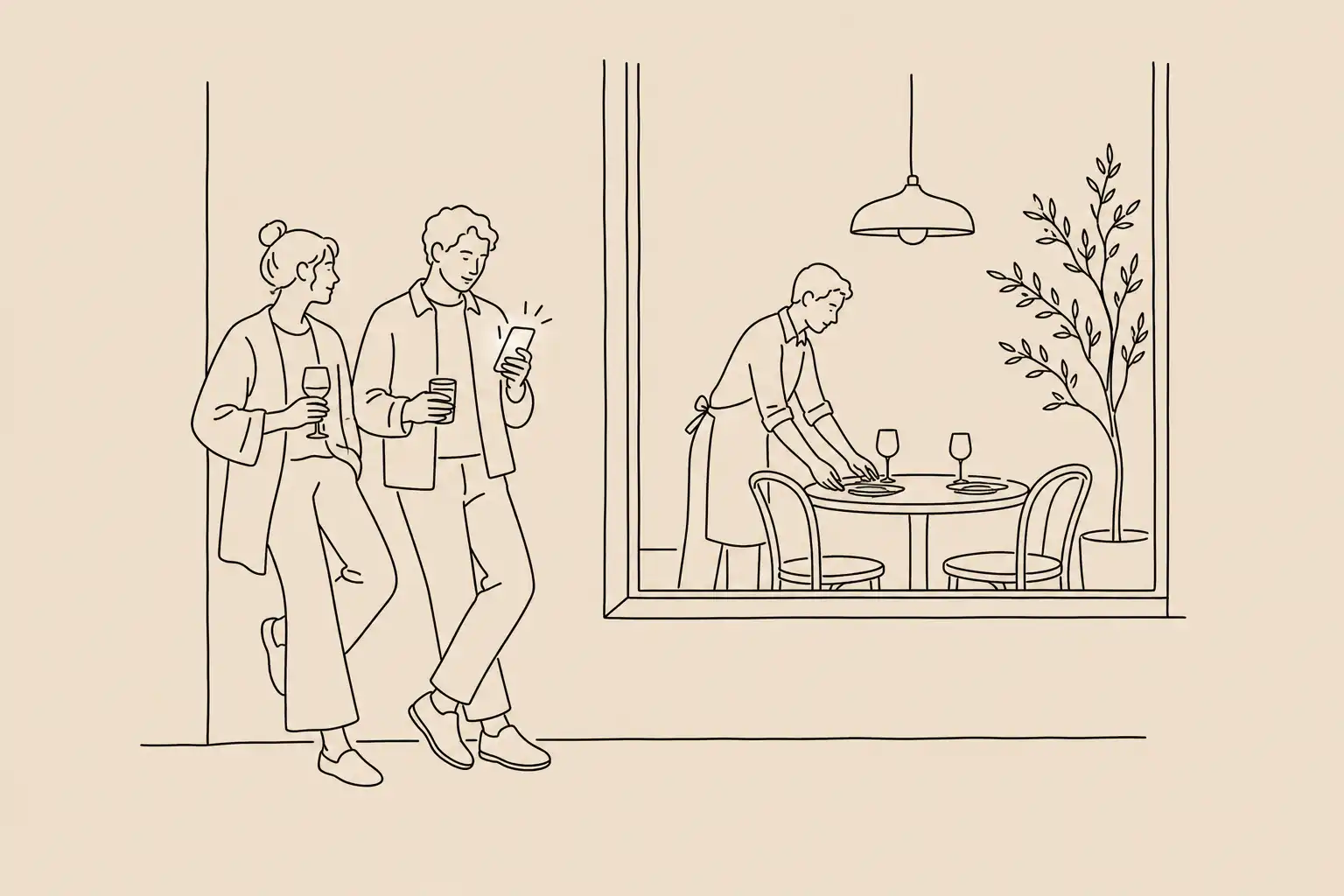
A clipboard handles the first job fine. It's shaky on the second and fails the third the moment the guest walks down the street for a drink. That third job is where pagers and apps earn their money.
One operator on Reddit summed up the gap this month: "I've just personally never seen a waitlist for counter service but we really do need one." The need shows up before anyone has gone shopping for software.

Reservation software. Free for Canadian restaurants. $0 a month
Clipboard, pagers or text-when-ready: which fits a small room?
| Method | Upfront cost | Monthly cost | Guest can leave the door? | Best for |
|---|---|---|---|---|
| Clipboard or notebook | $0 | $0 | No | Short waits, under 15 minutes, small lists |
| Guest pagers | Roughly $200 to a few thousand for a kit | $0 | Only within range (usually the block) | Food halls, patios, rooms where most guests don't carry a phone they'll check |
| Text-when-ready app | $0 | $0 to about $100 USD | Yes | Waits over 20 minutes, neighbourhoods with somewhere to go |
Pager prices vary widely. TablesReady's guide to restaurant pagers puts individual pagers at $10 to $60 each and full systems anywhere from $200 to $5,000. TablesReady sells a text-based waitlist, so read that with its interest in mind. Pagers also go missing, need charging, and stop working at the end of the block.
Text-when-ready wins for most independents for a simple reason: it lets the wait happen somewhere else. A guest who's having a pint next door isn't standing in your entrance making the room feel chaotic, and they aren't watching the clock.
What does a restaurant waitlist app cost in Canada?
Here are the published prices for the tools that come up most, checked October 2026. Most vendors show a "$" without naming the currency. Where they don't say, assume US dollars, which means roughly 40% more in Canadian dollars at the current rate of about $1.40 CAD per US dollar.
| Tool | Free tier | Entry paid plan | Next tier | Notes |
|---|---|---|---|---|
| Waitwhile | 50 visits/month, 1 location | From $31/month | From $55/month | 20% off annual. Paid plans can add a waitlist to Google Maps |
| TablesReady | 100 parties, 150 texts/month | $39 USD/month (annual) | $79 USD/month (annual) | Text quantities apply to US and Canada |
| Waitlist Me | Free version, limits not listed | $34.99/month ($27.99 annual), 1,000 notifications | $59.99/month, 2,500 notifications | $0.02 per extra notification |
| NextMe | Up to 100 texts/month | $49.99/month (billed annually, per NextMe) | $79.99/month | 14-day trial of paid features |
| Yelp Guest Manager | None | $129 to $349/month range | Demo required | Bundles reservations; Canadian availability not stated |
| TouchBistro Reservations | None | $229 CAD/month | Waitlist included with reservations, floor plan, two-way SMS |
Two things stand out.
The free tiers are trials with no end date. Fifty visits a month is about a dozen a week. If you only wait-list on Friday and Saturday nights in winter, that might cover you. If you run a Sunday brunch line of 40 parties, it's gone partway through the second Sunday.
The jump from standalone to bundled is large. A standalone waitlist app tops out around $100 USD a month. Once the waitlist comes bundled with a full guest manager or reservation suite, you're at $129 to $349. That's fine if you need the rest of the suite. It's a lot to pay for the waitlist alone.
What do the text messages really cost?
Less than most owners assume. Twilio, which sits underneath many of these apps, charges $0.0083 USD per text to a Canadian number, plus a carrier fee between $0.0064 and $0.0087 depending on the guest's carrier. That's about 1.5 to 1.7 cents US, or roughly 2 to 2.4 cents CAD, per message.
Here's what that means for a 50-seat room with a busy weekend:
| Per month | |
|---|---|
| Parties wait-listed (60 a weekend, plus 60 across the week) | 300 |
| Texts per party (added to list, table ready) | 2 |
| Total texts | 600 |
| Raw SMS cost at about 2.2 cents CAD | About $13 CAD |
Thirteen dollars. Nobody is getting rich on your waitlist texts. What you're paying for in a $35 to $80 plan is the host screen, the wait estimate, the history, and someone to call when it breaks at 7:45 on a Saturday. That's a fair thing to pay for. Just know which part costs what, so a plan priced "per notification" doesn't scare you off and a plan with a 150-text cap doesn't surprise you in week two.
One thing to keep clean: a "your table is ready" text is a reply to something the guest asked for. Adding that number to a promo list is a different act, and under Canada's anti-spam law it needs consent. If you want to market by text, our Canadian guide to SMS marketing for restaurants covers how to collect that consent properly.
Why does the quoted wait matter more than the app?
Because the guest judges the wait against what you told them, not against the clock.
David Maister's classic paper on the psychology of waiting lines sets out the rules every host learns the hard way: uncertain waits feel longer than known ones, unexplained waits feel longer than explained ones, and waiting before service starts feels longer than waiting during it.
The stakes are real. A Toast survey of US diners found 72% won't wait more than 30 minutes for a table. And a study of 94,404 guests at one busy restaurant, published in the Journal of Operations Management, linked longer waits to more walk-aways, shorter meals and a longer gap before guests came back. Its simulation put the revenue lost to waiting at close to 15% for that restaurant.
Apps help with the quote, but they don't make it accurate on their own. Toast's own help centre says its estimate is built on your average turn time and number of bookable tables, and lets you add a buffer when it runs short. Any app is only as good as those two inputs. A few habits matter more than which logo is on the tablet:
- Quote long, by five minutes. Seating someone early is a gift. Seating them late is a broken promise.
- Re-quote out loud when it slips. A text that says "running about 10 minutes behind" costs you nothing and buys you a lot.
- Don't quote from the reservation book alone. Count the tables that are actually close to done: dessert down, cheque requested.
Our position: if your quotes are already honest, a clipboard and a phone get you most of the way. If your quotes are wild guesses, no app will save the night.
Should the waitlist live in your reservation system?
If you take reservations and walk-ins on the same night, yes. This is the part the standalone app pages don't mention.
A waitlist and a reservation book both promise the same tables. When they live in two different tools, the host is doing the merge in their head: the 7:30 four-top is due in 20 minutes, the party of four on the list has been waiting 25, and the app on the second tablet doesn't know the first one exists. That's how a table gets promised twice.
How much of a problem that is depends on how you run your floor. In a designed hybrid, where you hold a set share of seats for walk-ins on purpose, the waitlist mostly feeds those held tables and a separate app can work. In an emergent hybrid, where walk-ins fill whatever no-shows and cancellations leave behind, the list and the book are fighting over the same seats all night, and they need to be in one place.
So a rough rule:
- Walk-in only, or waits only on a couple of nights a week: a standalone app, on the free tier until you outgrow it. Then the cheapest paid plan.
- Reservations most nights, a waitlist on the busy ones: use the waitlist built into your reservation software, or pick reservation software that has one. Paying separately for a second tool that doesn't talk to the first is the expensive version.
- Either way: don't pay $129 or more a month for a guest manager suite just to get a waitlist.
What should a small room do this week?
- Count. For two weekends, tally every party you put on a list, even on paper. That number decides whether a free tier works.
- Time your quotes. Write down the quote and the actual seat time for each party. If you're off by more than ten minutes on average, fix that first.
- Try one free tier on a real Saturday. Not a Tuesday. Waitwhile, TablesReady and NextMe all let you start without paying.
- Check what your reservation tool already includes. Plenty of owners pay for a waitlist app while their reservation software has one sitting unused.
When you're ready to take reservations, Trudy's Table is built for Canadian independents. Canadian owned, and free for Canadian restaurants.
Sources: Waitwhile pricing, TablesReady pricing, Waitlist Me pricing (Canada), NextMe pricing via Capterra, Yelp Guest Manager, Twilio SMS pricing, Canada, TablesReady, restaurant pagers, David Maister, The Psychology of Waiting Lines, De Vries, Roy and De Koster, "Worth the wait?" (Journal of Operations Management, 2018), Chowhound on Toast's wait-time survey, Toast Tables quote time help article.
Frequently Asked Questions
Is there a free restaurant waitlist app?
Yes. Waitwhile (50 visits a month, one location), TablesReady (100 parties and 150 texts a month) and NextMe (up to 100 texts a month) all have free tiers. They suit a room that wait-lists a few nights a week. A busy brunch or weekend dinner service will outgrow them within one or two weekends.
How much does a restaurant waitlist app cost?
Standalone apps run from free to about $100 USD a month for one location, with most entry plans between $31 and $50. Waitlists bundled into a guest manager or reservation suite cost more, from about $129 to $349 a month. Most vendors price in US dollars, so add roughly 40% for Canadian dollars.
Are restaurant pagers better than a text waitlist?
Pagers work in food halls, patios and rooms where guests stay close. They cost $200 to a few thousand upfront, go missing, and stop working outside their range. Text-when-ready lets guests wait anywhere, which makes longer waits feel shorter. For most independents with waits over 20 minutes, texting wins.
How do you give an accurate wait time at a restaurant?
Base the quote on tables that are actually close to finishing, not on the reservation book alone. Quote about five minutes long, and re-quote by text if it slips. Apps estimate from your average turn time and table count, so their quotes are only as good as those numbers.
Should a restaurant waitlist be part of the reservation system?
If you take reservations and walk-ins on the same night, yes. Both promise the same tables, and two separate tools leave the host merging them in their head, which is how tables get double-promised. Walk-in-only rooms can use a standalone app without that risk.